

If you live in Bellaire, West University, Meyerland, or River Oaks, you know that educational standards in our local community are exceptionally high.
Our neighborhoods are home to some of the most prestigious public magnet programs and elite private schools in Texas. From a young age, students here are immersed in a culture that values ambition, diligence, and achievement. They balance rigorous Advanced Placement (AP) tracks or International Baccalaureate (IB) coursework with competitive athletics, fine arts, leadership roles, and community service. On paper, these students look unstoppable.
At Bellaire Family Counseling, we regularly see the side of these bright young minds that doesn’t make it onto social media feeds or resume builder apps.
Behind pristine report cards and polished exteriors, an alarming number of local students are quietly drowning in academic anxiety.
When high performance is maintained by a hypervigilant, exhausted nervous system, the cost eventually comes due. Understanding how expectations fuel hidden anxiety, and learning how to foster both healthy ambition and genuine resilience, is vital for your child’s long-term wellbeing.
The Pressure-Cooker Culture: Anatomy of Local Expectations
Academic stress in Greater Houston’s high-achieving pockets doesn’t appear out of nowhere. It is woven into the fabric of daily life through an implicit “pipeline” mentality:
- The Early Pipeline: The push for competitive academic placement starts early—from navigating Vanguard and magnet lotteries to securing admissions at top-tier private middle and high schools.
- The Normalization of Overwork: In hallways across local schools, chronic sleep deprivation, late-night cramming, and packed schedules are often worn like badges of honor. When it seems like everyone else taking four AP classes, taking three can feel like slacking off.
- Hyper-Visible Comparison: Class rankings, test-score chatter in group chats, and the constant spotlight on college matriculation lists create an environment where students feel perpetually observed and evaluated.
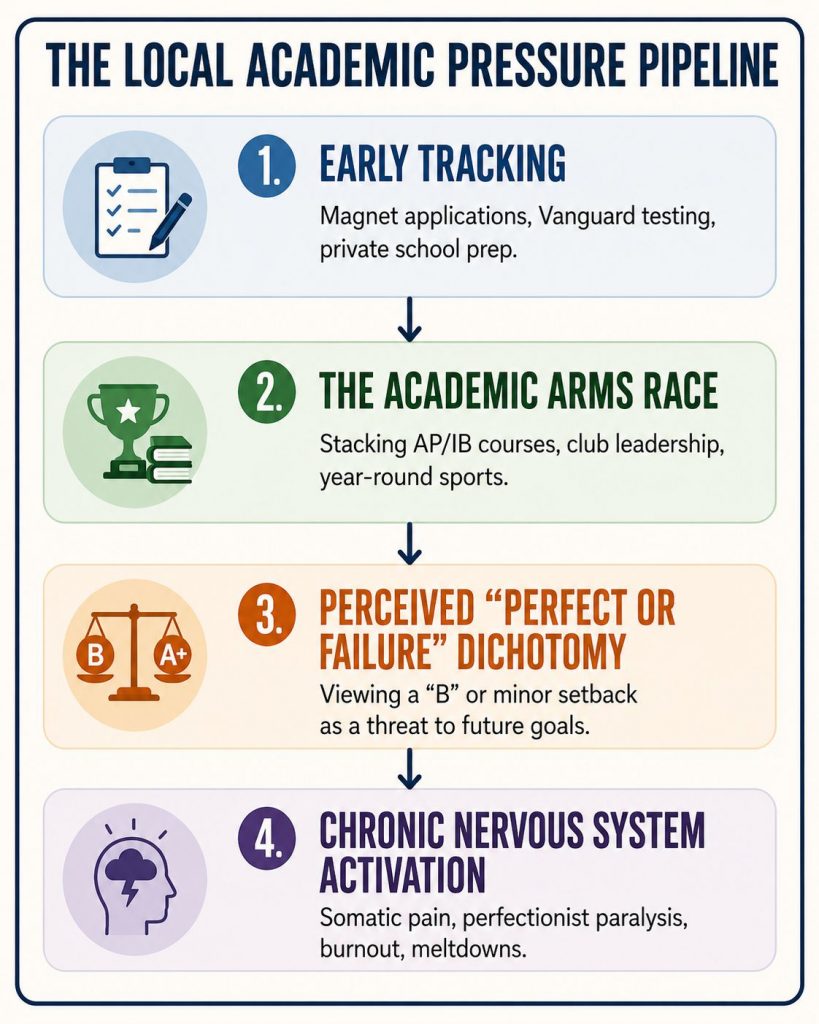
For a teenager navigating this environment, a single “B” on a progress report or a lower-than-expected SAT score isn’t viewed casually. To an anxious mind, it is processed as a potential catastrophic threat to their future security, self-worth, and place in the community.
How Academic Anxiety Shows Up in High Achievers
Because high-achieving kids are skilled at meeting expectations, their anxiety rarely looks like classic rebellion, truancy, or acting out in class. Instead, it manifests in subtler, internal ways:
1. Perfectionism & Over-Preparation
Anxious high achievers may spend much more time than needed on assignments. They may re-read textbooks, rewrite notes, or even freeze before starting for fear the first draft won’t be perfect.
2. Physical Somatic Complaints
Students may experience recurring Sunday night stomachaches, tension headaches, nausea on exam mornings, or severe sleep disruptions despite physical exhaustion.
3. Restraint Collapse at Home
Students who look composed, polite, and driven at school may fall apart when they step through the front door. The accumulated pressure from the day discharges as sudden irritability, sharp snapping at family members, or tearful emotional meltdowns over minor triggers.
4. Restlessness During Downtime
Slowing down gives the worry behind the scenes a chance to surface. If your child seems genuinely uncomfortable, guilty, or anxious when nothing is scheduled, they may need to relearn how to rest.
For practical ways to help your teen remember how to rest, read our guide: Why High-Performing Teens Still Need Time to Reset.
The Internal Toll: Performance vs. Self-Worth
One of the biggest dangers of chronic academic anxiety is the development of conditional self-worth. When the only positive feedback that young people receive is tied to their accomplishments, grades, and accolades, their brains can make a dangerous and inaccurate connection: “I am only valued when I am performing well.”

When a student’s entire identity is tied to their transcript, every academic challenge feels existential. They live in a state of chronic fight-or-flight, borrowing against their sleep, mental health, and personal relationships to maintain an image of effortless capability.
How Parents Can Counterbalance Community Pressure at Home
Parents cannot single-handedly change the competitive nature of the modern education system, but you have immense power to make your home a safe harbor from academic and community pressure.

Shift the Dinner Table Conversation
Intentionally change the questions you ask after school. Instead of leading with “How did you do on that math test?” or “Did you turn in your project?”, focus on connection: “What was the most interesting thing someone said today?” or “Is there anything you are looking forward to this week?”
Separate Self-Worth from Performance
Explicitly communicate that your love, pride, and acceptance have zero connection to their GPA. Don’t just assume that they know. Say it out loud.
“I love who you are as a person – your kindness, your curiosity, and your creativity. And I care about that a million times more than I care about any letter on a report card.”
Protect True Rest
Help your child establish firm boundaries around homework shut-off times. Encourage unstructured downtime, family meals without multi-tasking, and hobbies that carry no performance goals or college resume benefits.
How Therapy Helps High Achievers Thrive
Therapy for academic anxiety isn’t about telling your child to care less, drop their goals, or stop trying. It is about equipping them with tools to pursue excellence without being driven by fear.
At Bellaire Family Counseling, our Licensed Professional Counselors pull from several evidence based approaches when working with high-achieving youth across Bellaire, West U, Meyerland, and River Oaks.
- Cognitive Restructuring: Helping students identify perfectionist cognitive distortions, challenge catastrophic predictions, and uncouple their self-worth from external achievements.
- Somatic Regulation: Teaching youth to catch physical stress signals early and use body-based grounding tools to calm their nervous system during high-pressure moments.
- Metacognitive Skill-Building: Training teens to observe anxious thoughts without automatically treating them as facts, developing healthy boundaries around studying and sleep.
Reclaiming Balance and Joy
Your child can be ambitious, successful, and academically fulfilled without carrying a constant burden of chronic anxiety. By recognizing the hidden cost of high expectations early and providing grounded, evidence-based support, you help your child build a foundation of true resilience that will serve them for the rest of their lives.
At Bellaire Family Counseling, we work with children, teens, and families in person in the
Bellaire, Meyerland, West University, Westbury, River Oaks, Memorial, Piney Point and greater Houston area. Telehealth services are available anywhere in the state of Texas. You can reach us via phone or email at 713.300.8951 or info@bellairefamilycounseling.com. Or click here to schedule a consultation at a time that is convenient for you.
You might also find these helpful:
- When Achievement Hides the Problem: Recognizing Clinically Significant Anxiety in High-Achieving Kids and Teens
- Rest Isn’t the Enemy of High Performance – It’s What Makes It Possible
Is Your Teen’s Anxiety Holding Them Back: A Quick Guide for Parents